Language:


In composite manufacturing, leaving even a tiny strip of peel ply behind after demolding can cause catastrophic delamination during secondary bonding or painting. That's why high-visibility tracer lines (pin stripes) are a non-negotiable quality safeguard.
In composite material molding processes—such as Vacuum Infusion (VIP), Vacuum Bagging, Hand Lay-up, or Pultrusion—standard white or natural-colored nylon/polyester peel plies become translucent once saturated with resin, making them nearly indistinguishable from the underlying resin or reinforcement fibers.
The primary functions of a "tracer line" are as follows:
1. Prevention of Foreign Object Debris (FOD) / Zero-Defect Quality Control: High-contrast colored lines (e.g., red, blue, black, or fluorescent green) remain clearly visible even when saturated with resin. This ensures that no remnants of the peel ply are left behind, which could otherwise cause delamination or failure during secondary bonding.
2. Layup Alignment: When working with complex curvatures or large surface areas, these lines serve as warp/weft reference markers, helping to prevent the fabric from becoming distorted or wrinkled during application.
3. Shop-Floor Identification (Error-Proofing): In facilities that utilize multiple specifications—such as different fabric weights (e.g., 85gsm vs. 105gsm) or materials (e.g., PA66 vs. polyester)—tracer lines allow for quick, reliable differentiation based on variations in line spacing or color.
But did you know that tracer line spacing isn't one-size-fits-all? Choosing the right pitch improves shop-floor efficiency and FOD (Foreign Object Debris) control:
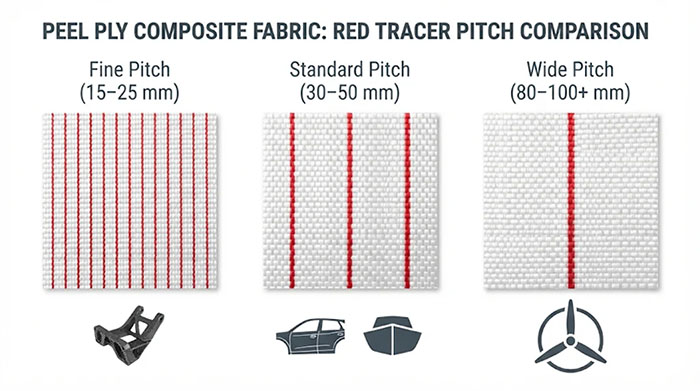
Fine Pitch (15–25 mm / ~0.6"–1.0")
• Why: Ideal for narrow slit tapes and intricate geometries. Guarantees every small cut piece carries at least one visible marker.
• Industries & Parts: Aerospace structural brackets, stringers, UAV frames, and medical composite devices.
Standard Pitch (30–50 mm / ~1.2"–2.0")
• Why: The industry workhorse. Balances instant post-cure visibility with effortless layup alignment across curved molds.
• Industries & Parts: Automotive carbon body panels, marine hulls & decks, rail interiors, and high-end sporting goods (bikes, skis).
Wide Pitch (80–100+ mm / ~3.0"–4.0"+)
• Why: Engineered for massive surface areas where long-distance alignment matters and excessive striping causes visual fatigue.
• Industries & Parts: Utility-scale wind turbine blades, large FRP storage tanks, and architectural panels.
We weave custom Nylon (PA6 / PA66) and Polyester peel plies with tailored widths, GSMs, and tracer line spacings to match your exact resin infusion or vacuum bagging workflow.
Need technical datasheets or free test swatches for your layup line? You can send email sales@ninezerotech.com to us today.
#CompositeManufacturing #Composites #VacuumInfusion #PeelPly #CarbonFiber #AerospaceManufacturing #WindEnergy #MarineComposites #FRP


